Edexcel GCSE Chemistry Tutors Online
Give every Chemistry question a clearer starting point.
- Verified tutors
- Free 15-minute introduction
- Edexcel experience
Verified tutors
ID + reference checked
Free 15-minute introduction
Meet your tutor and discuss your goals.
Edexcel experience
Tutors who teach your exam board.
Edexcel GCSE Chemistry tutors
View all 16 Edexcel GCSE Chemistry tutors £30/hr
Aishwariya K
Qualified Chemistry Teacher & Edexcel Examiner | Engaging GCSE Science & A-Level Lessons
Next available: Today 10:00am
 £45/hr
Ayobami S
Passionate and Dedicated Chemistry GCSE and A Level Tutor
Next available: Tomorrow 5:30pm
Usually replies within 8 minutes
 £25/hr
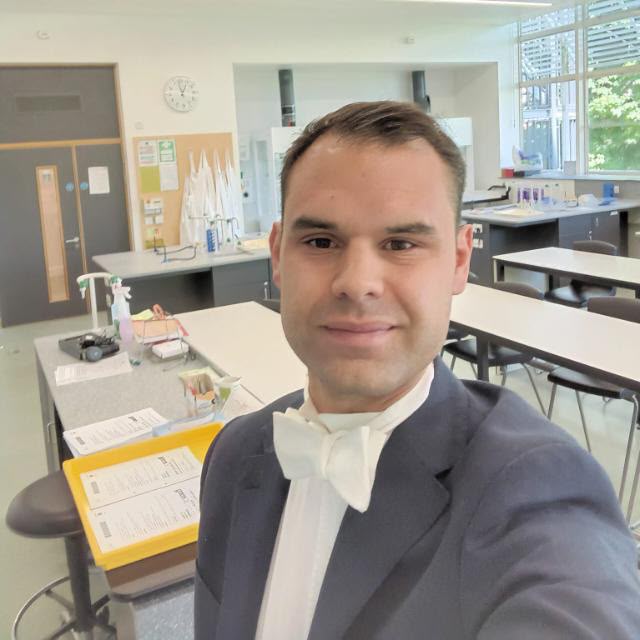
Charlie W
Second-Year Medical Student | GCSE & A-Level Chemistry Tutor | Build Confidence & Exam Skills
Next available: Today 8:00am
Usually replies within 3 minutes
 £60/hr
Philip S
Experienced Cambridge and Eton College Chemistry tutor
Next available: Today 3:00pm
 £67/hr
Michelle N
Expert Chemistry Tutor & Curriculum Specialist
Next available: Today 1:30pm
 £40/hr
Hassan A
Qualified Chemistry Teacher & SEN Specialist | Master the Concepts, Build Real Confidence
 £50/hr
Andrew V
Accessible, Engaging and Effective Chemistry Tutor
 £25/hr
Jason P
Custom Lessons to Build Exam Confidence | Chemistry Tutor with a Master’s Degree
Next available: Today 4:00pm
 £15/hr
Matthew M
Third-Year Chemical Engineering Student | Clear GCSE & A-Level Chemistry Tutor
Next available: Today 9:00am
 £25/hr
Noor-Fatima K
Experienced GCSE Chemistry Tutor | Clear Explanations & Exam-Focused Support
Next available: Today 11:00am
Contacted by 2 families this month
 £50/hr
Akanksha J
Experienced, Enthusiastic, Empathetic Chemistry Tutor
Usually replies within 11 minutes
 £45/hr
Nagasharan S
Dedicated, Engaging and Reliable Chemistry Tutor
 £36/hr
Felicia N
Engaging and Experienced Chemistry Tutor
 £30/hr
Boatemaa O
Student Centred Chemistry Tutor
 £30/hr
Rajesh G
Caring, experienced, dedicated and patient Chemistry tutor
 £100/hr
Andrea S
Engaging and experienced Chemistry Tutor Excited to help students
About Edexcel GCSE Chemistry
Help your child choose a method, then understand it
It can be frustrating to watch your child complete a worked example correctly and then get stuck when the numbers or wording change. In Chemistry, that can mean the method has been copied without the underlying decision becoming clear. Tuition can slow down that decision: what quantity do we know, what are we finding and which chemical idea connects them?
The same approach helps with written answers. Before reaching for remembered phrases, the learner can identify the substances, conditions and evidence in front of them. A good lesson makes those choices visible, then gradually gives the responsibility back to the learner.
Edexcel GCSE Chemistry: papers at a glance
| Paper | Code / tier | Duration | Marks | Weighting |
|---|---|---|---|---|
| Paper 1 | 1CH0/1F or 1CH0/1H | 1 hour 45 minutes | 100 | 50% |
| Paper 2 | 1CH0/2F or 1CH0/2H | 1 hour 45 minutes | 100 | 50% |
The Edexcel Chemistry paper split
| Paper | Topic groups |
|---|---|
| Paper 1 | Key concepts; states of matter and mixtures; chemical changes; metal extraction and equilibria; Separate chemistry 1 |
| Paper 2 | Key concepts; periodic-table groups; reaction rates and energy; fuels and Earth science; Separate chemistry 2 |
Keep the qualification code with your revision materials
This is GCSE Chemistry 1CH0, not International GCSE Chemistry or Combined Science. Key concepts are assessed on both papers. Use the school’s course and tier when choosing questions so practice matches the actual entry.
Core practicals: learn to justify the choices
Edexcel GCSE Chemistry includes eight mandatory core practicals. Examples include separating mixtures, electrolysis, making copper sulfate, titration, reaction rates, identifying ions and comparing fuels. Their methods and reasoning feed into the written assessment.
Ask the tutor to review a practical as a series of decisions. Why is that instrument suitable? Which observation signals the end point? What should be repeated? Which limitation remains after repeating? This approach lets the learner connect practical knowledge to a question that changes the substances or apparatus, rather than rely on recalling the classroom activity word for word.
Chromatography example: interpreting an Rf value
| Measurement or step | Original practice data |
|---|---|
| Distance from baseline to centre of the spot | 3.0 cm |
| Distance from baseline to solvent front | 5.0 cm |
| Rf calculation | 3.0 ÷ 5.0 = 0.60 |
| Units | No units: both distances use the same unit |
| Comparison | Compare with known substances tested under the same conditions |
A result needs its conditions
The chromatography calculation is short, but its meaning deserves attention. Both distances are measured from the baseline. An Rf value is a ratio, so it has no unit. A comparison with a reference substance is useful only when the relevant conditions match.
Follow up with a question about evidence: if an unknown sample has a spot matching a reference, what does that suggest, and what would strengthen the conclusion? This gives your child practice in making a measured scientific judgement. It also shows why a calculation alone may not answer the whole question.
Connect the course to meaningful questions
Separation and purity
Ask which physical property makes a separation method possible. Link the method to the mixture being studied rather than selecting equipment from memory.
Reaction conditions
Explore what changes when concentration, temperature or surface area changes. Use a particle explanation to account for a pattern in the results.
Materials and resources
Compare a material’s properties with its intended use, then consider the evidence behind environmental claims. A balanced answer needs specific information from the question.
Reaction-rate example: read a results table carefully
| Time / s | Gas collected / cm³ |
|---|---|
| 0 | 0 |
| 10 | 18 |
| 20 | 30 |
| 30 | 38 |
| 40 | 42 |
What the gas-volume results can and cannot tell you
Over the first 20 seconds, the mean rate of gas production is 30 ÷ 20 = 1.5 cm³/s. Between 20 and 40 seconds, it is (42 − 30) ÷ (40 − 20) = 0.6 cm³/s. The reaction is producing gas more slowly over the later interval.
These are mean rates across intervals, not exact rates at individual moments. Nor does the last reading prove the reaction is complete: the volume may still increase after 40 seconds. A tutor can use this original example to practise choosing evidence, labelling units and avoiding a conclusion that goes beyond the data.
Make feedback more useful than a corrected answer
When reviewing school work, sort errors into a few practical categories: an idea that was not understood, a method chosen incorrectly, a calculation slip or an answer that did not address the task. Each needs a different response. Rewriting the correct answer is only the beginning.
For example, an incorrect formula may need a return to chemical meaning, while a misplaced decimal may need an estimate and unit check. Ask your child to say what they will do differently next time, then use a new question to test that plan. This makes progress visible without reducing every lesson to a score.
A focused Chemistry lesson can follow this sequence
Recall
Start with a small check
Try a short task linked to previous learning. Use it to decide whether the current explanation is secure enough to build on.
Reason
Make one difficult decision explicit
Choose the method, identify the chemical idea or explain a practical choice. The tutor can model the reasoning before asking the learner to try it.
Apply
Change the context
Use different substances, values or evidence. Check whether the learner can recognise the same principle without copying the example.
Consolidate
Agree a short follow-up
Choose a manageable task and a way to check it. Revisit it at the next lesson so independent practice has a clear purpose.
Edexcel GCSE Chemistry: plan your exam preparation
| Stage | Useful preparation | What to confirm |
|---|---|---|
| Before revision | Use a recent assessment to identify topics and skills needing attention. | Qualification code, tier and the content assessed on each paper. |
| During practice | Combine topic questions with practical, graph and calculation work. | Use materials matching the specification and tier. |
| Before each paper | Review recurring errors and prepare the permitted equipment. | Check the official timetable and your school’s arrival instructions. |
Check your personal exam timetable
Check your exam board’s official timetable for the current examination dates. Your school or exam centre will confirm your individual timetable, arrival instructions, rooms and any access arrangements. Check for updates before making plans around the exam period.
Bring these details to your free introduction
- The qualification code and current tier, confirmed with school.
- One question that was difficult and any feedback already received.
- The current school topic and the date of the next assessment.
- Whether the priority is understanding, calculations, practical reasoning or exam confidence.
- The time realistically available for lessons and independent practice.
Choose tuition that fits the learner
The tutors on this page have indicated experience teaching the Edexcel board. Look at the individual profile for qualifications, teaching background and any additional support experience. Then ask how the tutor would approach your child’s example of difficult work.
The free 15-minute introduction is for meeting, discussing goals and planning the first lesson. It gives you a chance to agree what support would look like before committing to paid teaching. Prices and availability vary by tutor and should be checked on the current profile.
Frequently asked questions
Will lessons cover the extra separate-science content?
Confirm GCSE Chemistry 1CH0 and the learner’s tier with the tutor. Ask them to map the plan to the school’s specification, including the separate-Chemistry material, rather than use a general science revision list.
Can my child bring homework to a lesson?
Homework can reveal where understanding breaks down. Ask the tutor to guide the reasoning and then check a fresh example, so the learner can complete future work more independently.
Is learning practical methods enough?
Methods matter, but learners also need to explain choices, interpret results and evaluate limitations. Bring a practical record and ask the tutor to explore why its steps were necessary and what the evidence supports.
How can a parent help without knowing GCSE Chemistry?
Ask your child to explain the question they are working on and the next step they intend to take. You do not need to teach the content. Help them collect specific questions for the tutor and keep practice manageable.
Can we focus on Higher-tier calculation skills?
Discuss the exact topics and recent work with a suitable tutor. A clear plan should connect chemical meaning, mathematical steps and independent practice, rather than simply increase the difficulty of the numbers.
Official course information and further support
Assessment and practical details: Pearson Edexcel GCSE Chemistry specification (1CH0). Dates: Pearson exam timetables.
Course information checked on 16 September 2026. Teaching examples on this page are original illustrations, not official exam questions or mark schemes. You can also browse all GCSE Chemistry tutors if you need support with a different board.
Ready to find your tutor?
Book a free 15-minute introduction — meet your tutor and discuss your goals.